
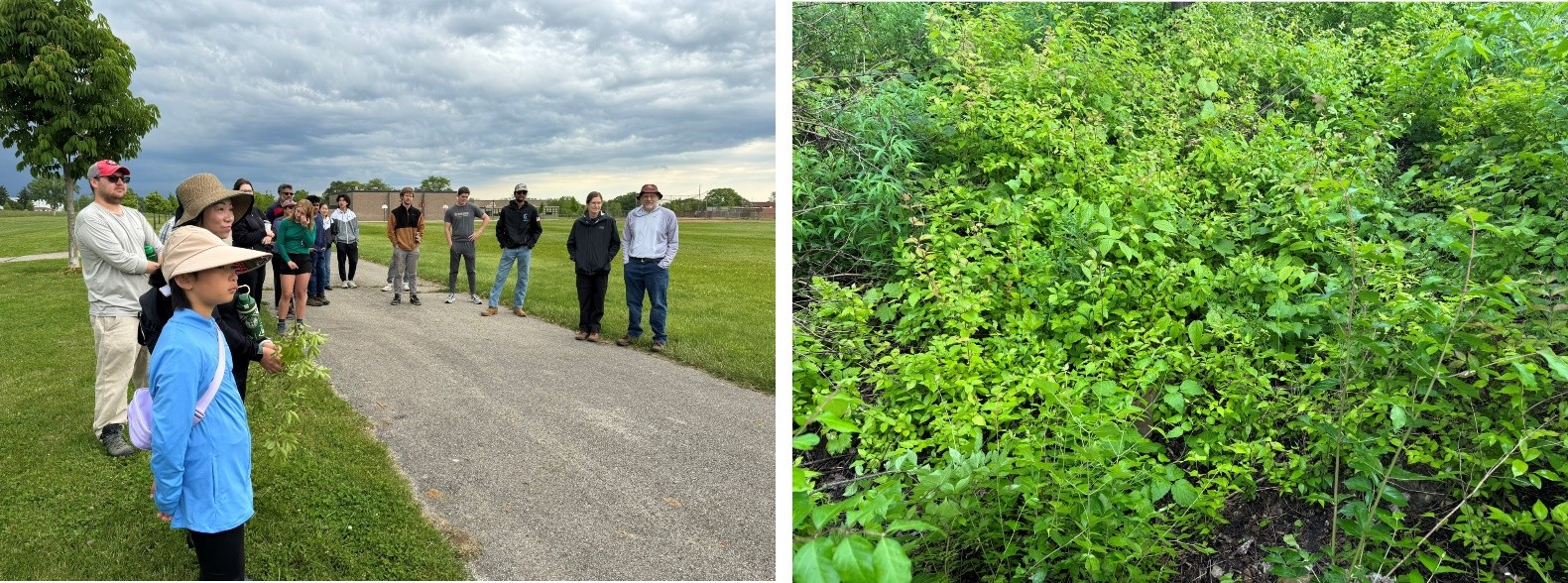
A group of about 20 volunteers joined us for our CRPD & SWAG event to attack honeysuckle along Dry Run at Westmoor Park. We tackled honeysuckle there in November 2025 and January 2026 hoping to prepare the area for planting native shrubs and trees here this fall. I came expecting a few small sprouts on bushes we had previously cut, but that we missed or regrew. Oh, what a surprise! We were “greeted” by a massive field of new honeysuckle. Perhaps I was more surprised than I should have been. I have previously cut honeysuckle with several other organizations where cut stems were immediately treated with herbicide (typically about 50% concentrated glyphosate). No herbicide was applied at Westmoor.
I came expecting a few small sprouts on bushes we had previously cut, but that we missed or regrew. Oh, what a surprise! We were “greeted” by a massive field of new honeysuckle. Perhaps I was more surprised than I should have been. I have previously cut honeysuckle with several other organizations where cut stems were immediately treated with herbicide (typically about 50% concentrated glyphosate). No herbicide was applied at Westmoor.
Here are several things we observed for growth from this spring’s growing season:
- The bushes we had cut last fall/winter had grown 20-40 shoots, 2-3ft long. Many trees and shrubs and especially invasive honeysuckles have a survival mechanism, where dormant buds hidden beneath bark (called epicormic shoots) start growing from energy stored in the root triggered by plant growth hormones.
- We also found many first-year honeysuckle seedlings. Since this area had many mature fruit-bearing plants, all these seedlings had grown up in the more open canopy we had created.
The opened canopy also led to more herbaceous plants including sedges, evening primrose, stick seed, dogbane, white avens, and golden rods.

How to proceed with this restoration effort?
Cut stem application of concentrated herbicide (50% glyphosate or imazapyr) immediately after cutting stems is the widely recommended and used method for eradicating honeysuckle. Especially when treated in fall or early winter, the herbicide applied to the cut stem is transported and taken up by the roots and kills or at least damages the plant. Though cut stem herbicide application is less effective in spring or early summer, many organizations nevertheless use cut stem treatment year-round.
As CRPD volunteers, we may not use herbicide. So, we need to learn about effective ways to eradicate honeysuckle without herbicide. For example, honeysuckle poppers are tools that grab the main trunk and with a leverage mechanism that allows yanking out the whole root. However, this works only for bushes with a main trunk of about 1.5-2”. It does not work for larger tree-like honeysuckle or multi-stem regrowth. Digging out honeysuckle roots with a pickaxe can be done but is slow back-breaking work. Some observations that may help: Honeysuckle does not grow in wetlands – could creating wet pools in the floodplain work? Further we observed along the Olentangy near Antrim Lake, that pawpaws were growing underneath large tree-like honeysuckle where the canopy was more open. Should one leave the very large honeysuckle to “thin” itself and perhaps just cut stems with berries to prevent further spread? Are there other ways based on the plant physiology of honeysuckle to interrupt that hormone triggered growth of epicormic shoots? Just some thoughts, further research is needed.

Here is what we tried at Westmoor:
- First year seedlings were easily pulled especially in wet soil after rain. Perhaps fall seeding of sedges or grasses can limit the growth of honeysuckles from seeds.
- We cut all shoots on some bushes that were cut last fall/winter, hoping that this will deprive the roots of nutrients and kill them. But again, that is slow work. We did not get many bushes done and marked a few so we can check our results. Alternatively, and faster, we gave larger areas a “haircut” with hedge trimmers. Looking at results later this season may give us some ideas on what works.
- Removing areas of honeysuckle freed some self-seeded trees, for example a patch of catalpa. Honeysuckle grows more vigorously in sun than dense shade. Can these trees outgrow and out-shade honeysuckle?
I’m not quite ready to give up. Though it’s going to be a huge challenge to eradicate honeysuckle without chemical help. Do we have enough helping hands to try to tackle this challenge or are we always going to be behind the aggressive growth of this nasty plant?

